

Description
TSE6081b – Flexible Package Integrity Tester for Large Flexible Packs
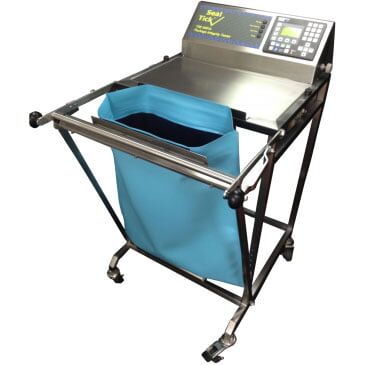
A large pouch of milk powder or a bag of snack food can look sealed and still pass air through a channel in the seal, and the pack cannot be opened to find out. The TSE6081b flexible package integrity tester is a trolley-based vacuum decay leak tester for large flexible packs of up to 600 mm × 500 mm. It tests the pack dry, without stressing or inflating it, so a pack that passes can go back onto the packing line. That makes it a non-destructive package leak testing option for food and pharmaceutical lines.
How vacuum decay leak testing works
The operator places the pack in the chamber and closes the handle, which starts the test. The tester generates vacuum from compressed air and draws it around the pack, then monitors the pressure in the chamber. If the pack leaks, gas escapes from it into the evacuated chamber and the pressure rises faster than it does for a sound pack. The tester compares that change with the settings stored for the product, and shows the result as a pass lamp, a fine fail lamp or a coarse fail lamp, with a quantitative result on a backlit display.
This vacuum decay leak testing machine reports whether a pack leaks and gives a quantitative result. It does not show where the leak is. When a pack fails, the TSE2032 water bath integrity tester is the secondary step: it finds the point of failure by showing a stream of bubbles.
Large flexible package leak tester
The TSE6081b accepts thin packs up to 600 mm × 500 mm × 25 mm. Thicker packs reduce the maximum height and width that fit. A flexible mounting system allows the standard chamber of the smaller TSE6086b to be fitted in its place, and the smaller chamber is recommended for smaller packs. For packs up to 360 mm × 300 mm, the TSE6086b is the compact choice. The TSE6081b suits large-format packs.
Micron leak detection for packaging
The best sensitivity on the TSE6081b specification is 20 micron, and the tester takes a high resolution measurement of leak rate. The figure achievable on a given pack depends on the pack and the test settings, so it is worth confirming on the packs in question. Most standard packs test in 5 to 45 seconds, and small packs can test in as little as 5 seconds.
Seal integrity data logging
Each result is written to an internal log. The log keeps 30 days of results, one file per day, and the 31st day clears the first. Records can be retrieved over Ethernet, or by the optional USB connection, for record keeping and trend identification, and results can also be monitored through a web browser. The tester holds 20 nameable test methods that can be programmed, so each product is tested with its own procedure, and test parameters sit behind password access.
Read More
Features and benefits
- Sensitivity: best sensitivity 20 micron, with high resolution measurement of leak rate.
- Test time: 5 to 45 seconds for most standard packs, as short as 5 seconds for small packs.
- Pack size: up to 600 mm × 500 mm × 25 mm, with a trolley-based format for large packs.
- Test methods and records: 20 nameable programmable methods, an electronic test record, and Ethernet or optional USB log retrieval.
- Services: 230 V AC (115 V AC available), 50 W mains power, compressed air at 60 L/min (intermittent), operating temperature 0 to 50 °C.
Applications and industries
Food and pharmaceutical package testing in Australia often involves large flexible packs that cannot be opened or discarded after a check. The TSE6081b suits dry products packed in air or modified atmosphere, in bags such as pillow and gusset styles.
- Milk powder packaging leak test: large bags where a seal fault lets in moisture or oxygen.
- Snack food packaging integrity testing: routine seal checks on snack food packs.
- Medical bandage packaging leak test: large flexible packs for medical products.
- Pharmaceutical and food seal checks: food packaging seal integrity testing where the pack must stay saleable after the test.
Vacuum-packed and liquid products are not suited to this tester. For other formats, see the TSE6089L flexible package integrity tester and the TSE6084 can integrity tester.
Compliance and standards
ASTM F2338 vacuum decay is the standard test method for non-destructive detection of leaks in packages by the vacuum decay method. It detects a leak by measuring the rise in pressure in an evacuated chamber that holds the pack, and its scope includes flexible, nonporous packages. Acceptance criteria are set by comparing baseline measurements from non-leaking control packs with measurements from leaking ones. The TSE6081b works on the same principle, as set out in the vacuum decay leak testing overview.
Pharmaceutical teams that run container closure integrity testing on flexible packs can include vacuum decay among their methods. The test method, settings and acceptance criteria for each product stay with the customer’s own quality system.
The TSE6081b comes with technical support from application engineers.

