

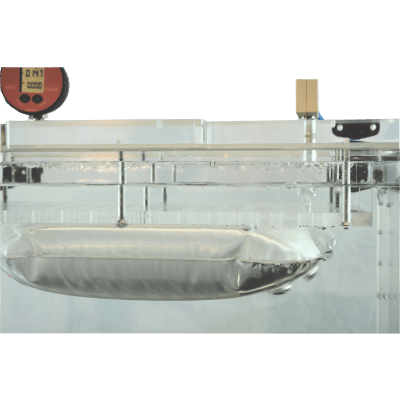
Description
TSE2032 – Water Bath Integrity Tester for Flexible Package Leak Location
Flexible packs such as pouches and sachets can leak at a seal, a fold or a pinhole in the film, and the quality team then needs to know where the fault is. The TSE2032 water bath integrity tester finds it by holding a pack under water in a transparent acrylic chamber and applying a vacuum. A stream of bubbles marks the leak. As a water bath leak tester, it shows where a pack is leaking, which makes it a leak location tester rather than a tool for measuring leak rate.
How the vacuum bubble test works
The operator lays the pack on the integrated grid, which keeps it submerged, and closes the lid. Switching the blue air supply lever on starts a compressed air driven vacuum generator, and an electronic vacuum gauge shows the vacuum in the chamber. As the pressure around the pack falls, the gas inside it expands and pushes out through any opening. The escaping gas rises as bubbles, and the point where the stream starts is the leak. Switching the lever off stops the test, and the chamber vents quickly.
A one-off adjustment to the pressure regulator sets the vacuum, and the setting can be changed between tests. Larger packs experience more force at the same vacuum, so the setting is matched to pack size to avoid over-stressing the seals. One approach is to estimate the stress a pack meets in service, from the factory floor to the supermarket shelf, and set the vacuum to match.
Bubble test, vacuum decay and pressure decay
This is a visual underwater package leak tester and a bubble leak tester that packaging teams read by eye. Put plainly, it is a bubble leak tester packaging engineers use to see the fault. Vacuum decay and pressure decay methods work differently. They monitor a pressure change and return a pass or fail result without showing where the leak is. The two can be used together: a decay tester gives the routine result, and the TSE2032 locates the fault on a pack that fails, alongside a system such as the TSE6086b.
Read More
Features and benefits
- Leak location: transparent acrylic chamber with 25 mm walls and an integrated grid that holds the pack under water, so the origin of the bubble stream can be watched through the walls and lid.
- Force on package: adjustable from 0 to 80 kPa at the pressure regulator, read on an electronic vacuum gauge.
- Maximum pack size: 400 mm × 300 mm × 200 mm (length × width × depth).
- Services and operating limits: compressed air at 25 to 110 L/min (intermittent), no electrical connection on the standard unit, operating temperature up to 70 °C.
- Handling: gas-spring assisted lid to reduce operator fatigue, an O-ring recessed in the lid to limit wear, and a drain valve so the chamber can be emptied before it is moved.
TSE2032-EC electronic control option
The TSE2032-EC adds an electronic control module in an IP67 water-tight enclosure. Immersion time and vacuum level are programmable, which adds repeatability from one test to the next, and the vacuum is shown on a remote electronic gauge. A push button starts the test, and a blue light in the button shows that it is running or complete. When it finishes, the vacuum turns off and the lid pops open as the pack floats up. The standard unit has no programmable test method and no electronic test record.
Applications and industries
Quality and packaging engineers looking for a flexible packaging leak tester in Australia or New Zealand can use the TSE2032 in food, pharmaceutical and medical device plants wherever the question is where a pack leaks, not how much.
- Food and beverage: batch checks on pouches and sachets, and food packaging seal integrity testing on packs that hold a gas headspace, including modified atmosphere packaging (MAP) for a MAP packaging leak test.
- Pharmaceutical: leak checks on sachets and blister packs as part of pharmaceutical package integrity testing.
- Medical devices: locating leaks in sterile barrier pouches as a sterile barrier leak test.
- Investigation and incoming checks: tracing the fault on a failed pack, and checking packaging material before it goes into production.
Two limits apply. A bubble test relies on gas escaping from the pack, so a pack with little or no headspace gas is a poor candidate. The pack is also wetted, so tested packs do not return to stock. Where packs must stay saleable, the TSE6081b, TSE6086b and TSE6089L flexible package integrity testers, and the TSE6084 can integrity tester, are the places to look for non-destructive package leak detection.
Compliance and standards
The ASTM D3078 bubble emission test is the standard method for finding leaks in flexible packaging. It covers gross leaks in packs that contain a headspace gas, tested while submerged in water under vacuum, which is the principle the TSE2032 uses. ASTM F2096 leak testing covers detecting gross leaks in packaging by internal pressurisation (bubble test), where the pack is pressurised from the inside instead of being drawn on by vacuum. It is a related reference, and the TSE2032 does not pressurise packs internally.
Both are test methods for gross leaks. Smaller leaks may need a more sensitive method, and the choice of method, vacuum setting and acceptance criteria stays with the customer’s own quality system.
The TSE2032 comes with technical support from application engineers.

